Buying guide8 min read
Solar street lights for government and industrial projects: all-in-one or split system?
Solar street lights make sense wherever running cable is expensive or the grid is unreliable: village roads, canal banks, forest and border roads, new layouts waiting for power. The first decision is the architecture. All-in-one lights put everything in one housing on the pole top; split systems keep the panel, battery and luminaire separate. Each has a place.
What is inside a solar street light
- Solar panel, sized to charge the battery on the worst month of the year, not the average one.
- Battery, now usually lithium iron phosphate (LiFePO4), which tolerates heat and deep cycling far better than older lead acid designs.
- Charge controller, preferably MPPT, which extracts more energy from the panel than a basic PWM controller, especially in hazy or partly cloudy conditions.
- LED luminaire with a dimming profile, and often a motion sensor that raises the output when someone approaches.
- Pole and mounting, designed for the wind load of the panel as well as the fitting.
All-in-one: simple to install, sensitive to heat
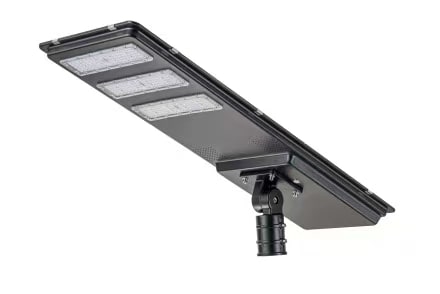
An all-in-one light integrates the panel, battery, controller and LED in a single housing. Installation is quick: mount it on the pole, point the panel south and switch it on. There are no exposed cables, and a battery at the pole top is harder to steal than a box at the base.
The trade off is size and temperature. The panel can only be as large as the housing, which limits the wattage and the hours of full output. The battery also sits directly under a panel in the sun. In much of India, summer housing temperatures run well above 50°C, so the battery chemistry, the thermal design of the housing and the controller's temperature protection matter a great deal.
Split systems: more capacity, more flexibility
A split system mounts a larger panel at the pole top on its own bracket, with the battery in a separate box or enclosure and a standard luminaire on the arm. The panel can be sized and tilted for the site, and the battery can be larger and kept cooler. Split systems suit higher wattages, longer operating hours and regions with long cloudy spells, at the cost of more installation work and cabling that must be protected.
Sizing that holds up in the monsoon
Two numbers drive sizing. The first is daily energy: fitting wattage multiplied by hours at each dimming step. The second is autonomy, meaning how many nights the light must run without sun. Specifications for public projects commonly ask for two to three days of autonomy. Panels are then sized from the solar resource in the worst month at the site, which in most of India means the peak of the monsoon.
| Factor | All-in-one | Split system |
|---|---|---|
| Installation time | Fast, single unit | Longer, separate components |
| Typical wattage | Lower | Lower to high |
| Battery temperature | Higher, at pole top under panel | Lower, in shaded enclosure |
| Panel size and tilt | Fixed by housing | Chosen for the site |
| Theft risk | Lower, no ground level box | Needs secure enclosure |
| Best for | Village roads, parks, pathways | Highways, long hours, cloudy regions |
Maintenance that is easy to forget
Dust on the panel is the most common cause of underperformance in north and west India. Build panel cleaning into the maintenance contract, and ask for a controller that logs charge and discharge so failures can be diagnosed without guesswork.
Published by Acromax Industries, Noida. Last reviewed . Standards are revised from time to time; the current tender document always governs.