Buying guide7 min read
LED flood lights for industrial and outdoor sites: wattage, beam angle and IP ratings
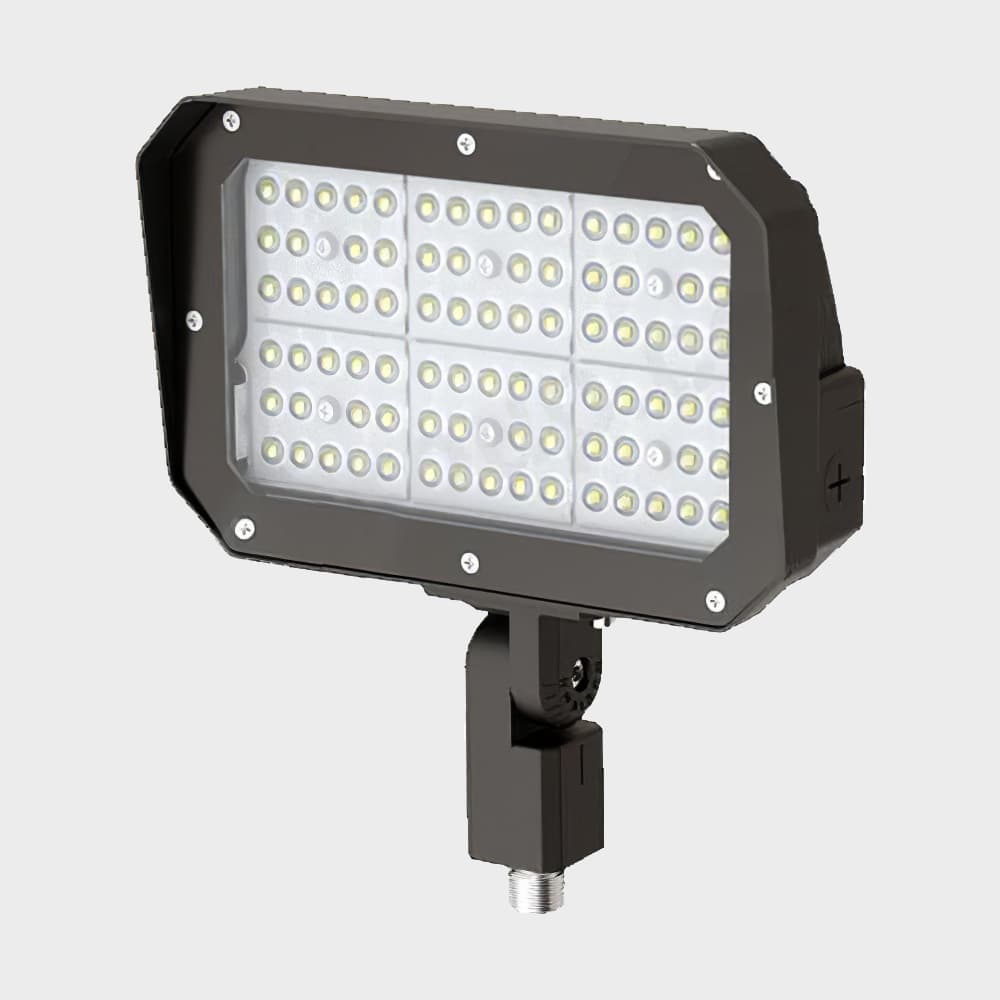
Flood lights do the heavy lifting on industrial sites: storage yards, loading bays, plant perimeters, mine benches and the tops of high masts. They are also the fittings most often bought on wattage alone. This guide covers the four decisions that actually determine whether a flood light does its job.
Start from lumens and the area, not watts
Watts measure what a fitting consumes. Lumens measure what it produces. Two 200 W flood lights can differ by a third in output depending on the LEDs, the driver and the optics. Specify the required illuminance on the area, ask for the lumen output and system efficacy of the fitting, and let the wattage follow.
Choose the beam angle for the throw
The beam angle decides where the lumens go. A wide beam spreads light over a nearby area; a narrow beam throws it far. Using the wrong one either wastes light or leaves dark patches between fittings.
| Beam | Throw | Typical use |
|---|---|---|
| Narrow, 15 to 30° | Long | High masts over 20 m, towers, long perimeter runs |
| Medium, 45 to 60° | Medium | Masts of 12 to 20 m, stockyards, building facades |
| Wide, 90 to 120° | Short | Loading bays, sheds, low mounted area lighting |
| Asymmetric | Forward | Perimeter walls and sports areas where spill and glare matter |
On a high mast, fittings are usually mixed: narrow beams aimed at the far edge of the area and wider beams for the zone near the base. A supplier should be able to show this in the photometric layout.
Build quality for outdoor duty
- IP66 for dust tight construction and resistance to powerful water jets, which is the practical minimum outdoors in India.
- Die cast aluminium housing with real heat sink area. LED life depends on junction temperature, and in a 45°C summer the heat sink is doing most of the work.
- Toughened glass front and an IK rating where the fitting is within reach or near moving machinery.
- Surge protection in the driver, commonly 10 kV for fittings on long outdoor cable runs.
- Stainless or galvanised mounting bracket with an angle scale, so fittings can be re-aimed to the drawing after maintenance.
Colour temperature and colour rendering
Cool white around 5700 K is standard for security, yards and mines, where contrast and alertness matter. Neutral white around 4000 K is easier on the eye for campuses, facades and areas where people work for long periods. A colour rendering index of 70 or above is usual for outdoor area lighting; CCTV coverage benefits from higher values.
Replacing metal halide and sodium
Many sites still run 400 W and 1000 W metal halide or high pressure sodium flood lights. LED replacements typically draw well under half the wattage for similar useful light on the ground, start instantly after a power interruption, and do not need warm-up or restrike time. Compare replacements on measured illuminance on the ground rather than on lamp wattage, because LED optics put more of their output where it is needed.
Published by Acromax Industries, Noida. Last reviewed . Standards are revised from time to time; the current tender document always governs.