Standards8 min read
Flameproof LED well glass luminaires: hazardous zones, gas groups and certification in India
In a refinery, a paint shop or a fuel depot, a light fitting is a potential ignition source. Flameproof luminaires are built so that an ignition inside the fitting cannot escape and ignite the atmosphere outside. Specifying them correctly means reading a short code on the label, and knowing which authority's approval your site needs.
Start with the area classification
Hazardous areas are classified by how often an explosive atmosphere is present, following IS/IEC 60079-10-1 for gases and vapours.
| Zone | Explosive atmosphere is present | Typical equipment protection level |
|---|---|---|
| Zone 0 | Continuously or for long periods | Ga |
| Zone 1 | Likely in normal operation | Gb |
| Zone 2 | Not likely, and only briefly if it occurs | Gc |
Lighting is rarely installed in Zone 0. Most flameproof well glass fittings are specified for Zone 1 and Zone 2. Dust hazards use a parallel scheme of Zones 20, 21 and 22.
Read the gas group and temperature class
The marking on a certified fitting looks something like Ex db IIC T6 Gb. Each part matters.
- Ex db is the protection concept: a flameproof enclosure, to IS/IEC 60079-1.
- IIA, IIB or IIC is the gas group. IIA covers gases such as propane, IIB covers gases such as ethylene, and IIC covers hydrogen and acetylene. A IIC fitting is also suitable for IIB and IIA. Group I is reserved for underground mines with methane.
- T1 to T6 is the temperature class, the maximum surface temperature of the fitting: T1 450°C, T2 300°C, T3 200°C, T4 135°C, T5 100°C and T6 85°C. It must be below the ignition temperature of the gases present.
- Gb is the equipment protection level, which must match the zone.
Certification in India
Flameproof equipment is tested at a recognised laboratory, such as CIMFR in Dhanbad, against the IS/IEC 60079 series. For petroleum refineries, depots and other installations under the Petroleum Rules, the equipment also needs approval from PESO, the Petroleum and Explosives Safety Organisation. Equipment for underground coal mines needs approval from the DGMS. Ask for the test certificate and the approval letter for the exact model, gas group and temperature class you are buying.
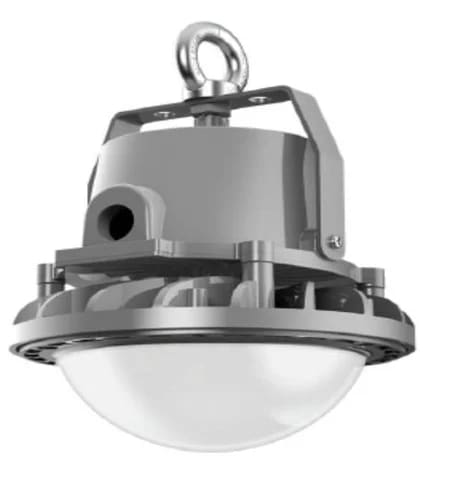
How a well glass fitting is built
- A cast housing, usually low copper aluminium alloy, with machined flamepaths of controlled gap and length
- A thick toughened or borosilicate glass well, protected by a wire or cast guard
- Certified cable entries and glands; an uncertified gland defeats the enclosure
- A driver and LED module sized so the surface temperature stays inside the marked temperature class
Why LED suits hazardous areas
Every maintenance visit in a hazardous area needs a permit and often a shutdown of the surrounding equipment. LED well glass fittings last far longer than the sodium and metal halide lamps they replace, run cooler, and restart instantly after a trip. Fewer visits is a safety benefit in its own right.
Published by Acromax Industries, Noida. Last reviewed . Standards are revised from time to time; the current tender document always governs.